Is Our Food Less Nutritious Than It Was 100 Years Ago? The Truth About Modern Nutrition
The Short Answer: Some Nutrients Have Declined, but Our Diets Have Changed Even More
Is the food we eat today as nutritious as the food our grandparents and great-grandparents ate? The answer is that some foods may contain lower concentrations of certain nutrients than they did decades ago, but the biggest nutritional challenge today is often the combination of how food is grown, how it is processed, and what we choose to eat.
Research has documented declines in certain nutrients in some crops over the past several decades. At the same time, modern agriculture has improved food availability, food safety, and access to a wider variety of foods. The evidence does not establish that all modern food is less nutritious than food consumed 60 or 100 years ago.
From a holistic health perspective, however, an important question remains: Are we consistently giving our bodies the nutritional building blocks they need to function optimally?
Vitamins, minerals, amino acids, essential fatty acids, and other nutrients support energy production, immune function, hormone regulation, healthy bones, and brain function. When nutrient intake falls short, the effects may be subtle at first and become more noticeable over time.
Understanding how our food supply has changed can help us make better decisions about nutrition, lifestyle, and the appropriate use of dietary supplements.
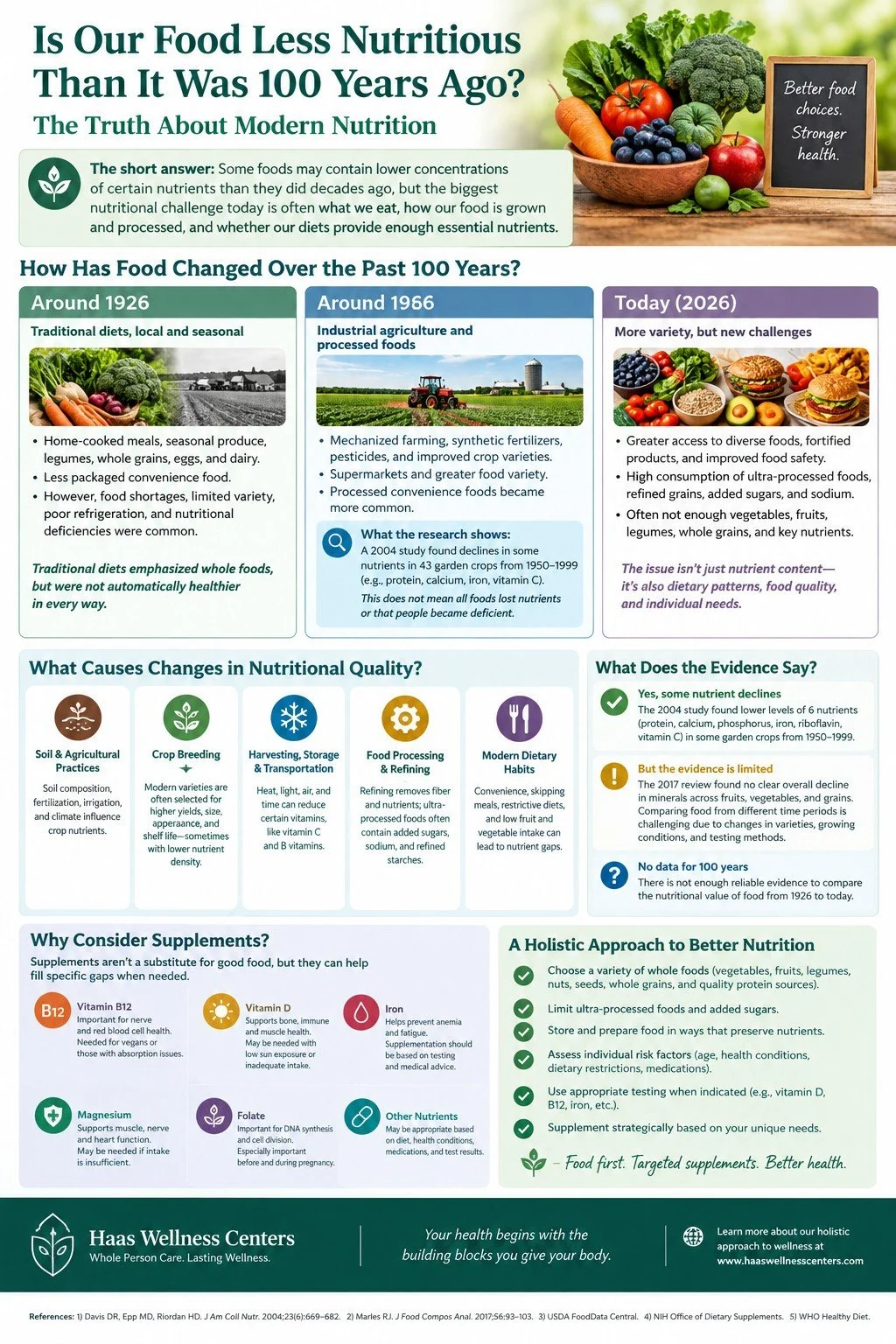
How Has Food Changed Over the Past 100 Years?
Around 1926: A Different Relationship With Food
A century ago, many families prepared meals at home using locally available produce, eggs, meat, dairy products, legumes, and grains. Fruits and vegetables were often seasonal, and food preservation relied more heavily on methods such as canning, drying, and fermentation.
Packaged convenience foods were less common than they are today. However, traditional diets were not universally healthier. Food shortages, limited dietary variety, poor refrigeration, and nutritional deficiencies were significant problems, particularly among economically disadvantaged populations.
People also experienced greater physical demands in daily life, and access to certain foods depended heavily on where they lived.
The lesson is not that every food was better 100 years ago. Rather, many traditional dietary patterns emphasized home-prepared meals and less highly processed food.
Around 1966: Industrial Agriculture Transforms the Food Supply
By the 1960s, mechanized farming, synthetic fertilizers, pesticides, improved irrigation, and selective crop breeding were transforming agricultural production. Supermarkets expanded, refrigeration and transportation improved, and processed convenience foods became increasingly popular.
These developments increased food availability and helped reduce certain forms of food insecurity. They also changed how crops were grown, selected, stored, and distributed.
A landmark 2004 study by Donald Davis and colleagues examined historical USDA nutrient data for 43 garden crops between 1950 and 1999. The researchers identified apparent declines in several nutrients across the group, including protein, calcium, iron, and vitamin C.
They proposed that changes in crop varieties and agricultural practices could explain some of these findings. One possible mechanism is a dilution effect: If a plant produces more carbohydrates or grows larger without a proportional increase in certain minerals or vitamins, nutrient concentrations per unit of food may decline.
Importantly, the study did not establish that all crops lost nutrients or that every nutrient declined. Historical data also have limitations, including changes in sampling and analytical methods.
Nevertheless, the research helped stimulate further investigation into the nutritional composition of modern crops.
Today: Greater Food Availability, but New Nutritional Challenges
In 2026, we have access to an extraordinary variety of foods. Fresh produce is available year-round, many staple foods are fortified with vitamins and minerals, and food safety systems have improved substantially.
Yet many people consume diets high in ultra-processed foods, refined grains, added sugars, and excess sodium. These products can supply abundant calories while providing relatively little fiber and limited amounts of certain essential nutrients.
This creates an important distinction: A food supply can provide more calories and greater convenience without necessarily producing better overall dietary quality.
The modern nutritional challenge is therefore twofold. Some changes in crop composition may affect nutrient concentrations, while dietary habits can determine whether people consume enough nutrient-rich foods in the first place.
Five Factors That May Affect the Nutritional Value of Food
1. Soil Quality and Agricultural Practices
Plants obtain minerals from the soil, and soil conditions influence the nutrients available for plant growth. Soil composition, pH, irrigation, fertilization, and agricultural management can all affect crop nutrient profiles.
Intensive farming can remove nutrients from soil when they are not adequately replenished. However, soil nutrient depletion varies by location and farming practice, and it has not been established as the single explanation for reported historical declines in food nutrients.
Sustainable soil management, crop rotation, and appropriate fertilization can help maintain productive agricultural systems.
2. Selective Breeding of Crops
Modern crops are frequently selected for yield, size, appearance, disease resistance, durability, and transportability.
These characteristics are valuable for farmers and consumers, but nutrient concentrations do not always increase alongside crop yield.
Some research suggests that selective breeding and changes in crop varieties may contribute to differences in nutrient composition. Plant breeders can also deliberately select for improved nutritional characteristics, demonstrating that crop genetics can be part of the solution.
3. Harvesting, Transportation, and Storage
Some vitamins, particularly vitamin C and certain B vitamins, can deteriorate during prolonged storage or exposure to heat, light, and air.
The extent of nutrient loss depends on the food, storage conditions, transportation time, and preparation method. Frozen produce can retain nutrients well because it is often processed shortly after harvesting.
Consequently, fresh food is not automatically more nutritious than frozen food.
4. Food Processing and Refining
Processing ranges from beneficial methods, such as pasteurization and freezing, to practices that remove valuable components from food.
Refining whole grains, for example, removes much of the bran and germ, reducing fiber and naturally occurring nutrients. Enrichment restores selected nutrients, such as certain B vitamins and iron, but does not necessarily replace everything removed.
Many ultra-processed foods also contain substantial amounts of added sugars, sodium, or refined starches. When these products displace vegetables, fruits, legumes, nuts, and whole grains, overall nutrient intake may suffer.
5. Modern Dietary Habits
Perhaps the most important factor is what people actually eat.
A person can consume enough calories—or even too many calories—while still having inadequate intake of specific vitamins and minerals.
Skipping meals, eating few vegetables, following restrictive diets without careful planning, and relying heavily on packaged convenience foods can all contribute to nutritional gaps.
Digestive disorders, certain medications, aging, and increased nutrient requirements can further complicate the picture.
How Can Nutritional Deficiencies Affect Health?
The body depends on a steady supply of essential nutrients to maintain normal physiological functions.
For example:
Iron and vitamin B12 are important for red blood cell production and oxygen transport. Deficiencies can contribute to anemia and fatigue.
Vitamin D and calcium support bone health and normal muscle function.
Magnesium participates in hundreds of biochemical reactions, including those involved in muscle and nerve function.
Zinc supports immune function, wound healing, and normal growth.
Folate is essential for DNA synthesis and cell division.
Essential fatty acids contribute to cell membranes and other important physiological processes.
Nutritional deficiencies do not always produce obvious symptoms immediately. Fatigue, weakness, poor concentration, and other nonspecific complaints can have nutritional causes, but they can also arise from thyroid disorders, anemia, sleep problems, medication effects, and many other conditions.
That is why persistent symptoms should be evaluated rather than automatically attributed to poor food quality or a nutritional deficiency.
Why Consider Dietary Supplements?
Even a person who tries to eat a healthy diet may not consistently meet every nutritional requirement. Individual needs vary according to age, dietary patterns, digestive function, health conditions, medications, and other factors.
The rationale for supplementation is straightforward: When a nutrient is missing or insufficient, providing an appropriate amount can help correct the deficiency and support normal physiological function.
Examples include:
Vitamin B12: People following strict vegan diets generally need a reliable source of B12 from fortified foods or supplements. Some individuals also require supplementation because of impaired absorption.
Vitamin D: Supplementation may be appropriate when dietary intake is inadequate or a deficiency is identified.
Iron: Supplementation can help treat confirmed iron deficiency, but the cause should be investigated. Excess iron can be harmful.
Magnesium: Supplementation may be considered when intake is inadequate or there is a specific clinical indication.
Folate: Adequate intake is particularly important before conception and during early pregnancy. People who may become pregnant should follow established folic acid recommendations.
Other vitamins and minerals: Supplementation may be appropriate when dietary assessment, medical history, or testing identifies a specific need.
Not everyone needs a multivitamin, and taking more supplements does not necessarily produce better health.
Excessive doses of certain nutrients can cause toxicity. Supplements can also interact with prescription medications or be inappropriate for people with particular medical conditions.
A thoughtful approach emphasizes food first, identifies individual risk factors, and uses supplements to address specific nutritional needs rather than attempting to compensate for every perceived problem in the modern food supply.
What Is the Best Holistic Approach to Nutrition?
A practical strategy involves several steps:
Choose a diverse range of whole foods. Emphasize vegetables, fruits, legumes, nuts, seeds, and appropriately selected whole grains, along with suitable protein sources.
Reduce reliance on ultra-processed foods. Limit products that provide substantial added sugars, sodium, and refined carbohydrates while displacing more nutritious choices.
Consider food preparation and storage. Store foods appropriately and use cooking methods that preserve nutrients where practical.
Evaluate individual nutritional risks. Dietary restrictions, digestive problems, certain medications, and life-stage changes may increase the likelihood of deficiencies.
Use appropriate testing when indicated. Depending on symptoms and risk factors, a healthcare professional may consider a complete blood count, iron studies, vitamin B12, vitamin D, or other targeted tests.
Supplement strategically. Select products and doses based on established recommendations, identified deficiencies, and individual circumstances.
Whole foods provide more than isolated vitamins and minerals. They also contain fiber and a wide variety of beneficial plant compounds that supplements cannot fully reproduce.
The goal is to build a strong nutritional foundation and use supplementation when it provides a clear benefit.
How Haas Wellness Centers Can Help
At Haas Wellness Centers, our holistic approach emphasizes understanding the factors that may affect nutritional balance and overall wellness.
Depending on individual circumstances, an evaluation may include reviewing dietary habits, discussing digestive health and lifestyle factors, and considering appropriate laboratory testing to investigate possible nutrient deficiencies.
For individuals experiencing persistent fatigue, difficulty concentrating, or concerns about nutritional health, identifying potential contributing factors is an important first step. Nutritional deficiencies are one possibility, but symptoms can have many causes and may require a broader evaluation.
Our goal is to help individuals make informed decisions about nutrition, lifestyle, and appropriate supplementation based on their unique needs.
Your health begins with the building blocks you give your body. Rather than assuming that all modern food is deficient, focus on eating a varied, nutrient-dense diet, addressing individual nutritional gaps, and using supplements thoughtfully.
Visit Haas Wellness Centers to learn more about our holistic approach to wellness.
References and Further Reading
Davis DR, Epp MD, Riordan HD. Changes in USDA food composition data for 43 garden crops, 1950 to 1999. Journal of the American College of Nutrition. 2004;23(6):669–682. https://doi.org/10.1080/07315724.2004.10719409
Marles RJ. Mineral nutrient composition of vegetables, fruits and grains: The context of reports of apparent historical declines. Journal of Food Composition and Analysis. 2017;56:93–103. https://doi.org/10.1016/j.jfca.2016.11.012
U.S. Department of Agriculture. FoodData Central: Food composition and nutrient data. https://fdc.nal.usda.gov/
National Institutes of Health, Office of Dietary Supplements. Fact sheets for health professionals on vitamins, minerals, recommended intakes, and supplement safety. https://ods.od.nih.gov/factsheets/list-all/
World Health Organization. Healthy diet: Recommendations on dietary patterns, fruit and vegetable intake, free sugars, and sodium. https://www.who.int/news-room/fact-sheets/detail/healthy-diet
